
School holidays are here, which means more time at home, fewer routines and, if you’re a parent, possibly a few more cries of “I’m bored!”
While it can be tempting to rely on screens, outings and endless activities to keep kids entertained, the school holidays can also be a great opportunity to bring children into the kitchen.
Food activities aren’t just about making something delicious at the end.
They can be a chance for children to explore new foods, develop practical skills, become more comfortable around food and have fun with the whole process.
And the best part?
You don’t need to be a master chef.
Some of the best food activities are incredibly simple.
Whether your child loves getting messy, enjoys following instructions, prefers sensory play or is reluctant around new foods, there are plenty of ways to make food part of the school holiday fun.
Why get kids involved with food?
Children learn about food through much more than simply eating it.
Touching, smelling, looking at, preparing and talking about food can all contribute to building familiarity.
For children who are hesitant about trying new foods, this can be particularly useful.
There doesn’t need to be pressure to taste anything.
Simply washing a strawberry, touching a vegetable, helping mix ingredients or arranging food on a plate can be a positive food experience.
For children who are already comfortable around food, cooking provides an opportunity to develop practical skills and independence.
Depending on their age, children can learn how to:
- Measure ingredients
- Pour and mix
- Use kitchen utensils
- Follow a recipe
- Prepare simple snacks
- Wash fruit and vegetables
- Help with meal preparation
- Make choices about ingredients
- Clean up afterwards
These are skills they’ll continue to use well beyond the school holidays.
1. Create your own snack platter
Give your child a selection of foods and let them design their own snack platter.
You could include:
- Fruit
- Vegetables
- Cheese
- Crackers
- Yoghurt
- Hummus
- Nuts or seeds, where age-appropriate and safe
- Wholegrain toast
- Popcorn, where age-appropriate
- Leftover cooked vegetables
- Dips
Let them decide how they want to arrange everything.
Maybe they make a face.
Maybe they make a rainbow.
Maybe everything gets placed into separate sections.
There doesn’t need to be a “right” way to do it.
This is also a great opportunity to introduce a food your child doesn’t usually eat alongside familiar foods without requiring them to taste it.
2. Make homemade pizzas
Pizza is an easy school holiday activity because children can be involved at almost every stage.
Start with a base such as:
- Wholemeal pita bread
- English muffins
- Flatbread
- Lebanese bread
- Homemade dough
- Wraps
Then provide a selection of toppings.
Try:
- Tomato or pizza sauce
- Cheese
- Chicken
- Tuna
- Ham
- Capsicum
- Mushrooms
- Corn
- Pineapple
- Tomato
- Spinach
- Olives
Let everyone create their own pizza.
This gives children some control over what goes onto their food while also providing an opportunity to explore different ingredients.
And let’s be honest — food tends to taste better when you’ve made it yourself!
3. Have a fruit and yoghurt “café”
Turn afternoon snack into a pretend café.
Set up a few bowls containing different ingredients and let your child create their own yoghurt bowl.
For example:
- Greek yoghurt
- Berries
- Banana
- Mango
- Apple
- Pear
- Rolled oats
- Wholegrain cereal
- Chia seeds
- Crushed nuts, where appropriate
- Cinnamon
They could even make a menu and give their creation a name.
“Superhero yoghurt bowl” anyone?
This activity combines food preparation, creativity and imaginative play.
4. Make your own smoothies
Smoothies are another great activity because children can help choose the ingredients, measure them and blend everything together.
Try combinations such as:
Banana + milk + Greek yoghurt + cinnamon
Berry + banana + milk + yoghurt
Mango + banana + milk
Pineapple + banana + yoghurt
You can also add ingredients such as oats, nut butter or chia seeds depending on your child’s preferences and nutritional needs.
If your child is hesitant about certain fruits or ingredients, they can simply be involved in preparing them rather than being expected to drink the finished smoothie.
Remember: exposure doesn’t always have to end with eating.
5. Bake something together
School holidays are perfect for a little baking.
You could make:
- Banana muffins
- Apple and cinnamon muffins
- Pikelets
- Scones
- Homemade pizza scrolls
- Cheese and vegetable muffins
- Oat cookies
- Homemade bread
- Bliss balls
Children can help measure, pour, mix and decorate.
Baking can also be a great way to introduce concepts such as fractions, measurements and following instructions without it feeling like schoolwork.
And there’s usually something delicious to eat at the end!
6. Build a food rainbow
Challenge your child to create a rainbow using different coloured foods.
Red might be:
- Strawberries
- Tomatoes
- Red capsicum
- Watermelon
Orange:
- Carrots
- Mandarin
- Orange
- Pumpkin
Yellow:
- Banana
- Corn
- Yellow capsicum
- Pineapple
Green:
- Cucumber
- Kiwi fruit
- Peas
- Avocado
Blue and purple:
- Blueberries
- Purple cabbage
- Blackberries
- Purple carrots
You don’t need to find every colour.
The activity is simply about noticing the amazing variety of colours found in food.
7. Go on a supermarket scavenger hunt
Turn your next grocery shop into a game.
Give your child a list of things to find.
For example:
“Can you find a fruit you’ve never tried?”
“Can you find something that grows underground?”
“Can you find a food that is green?”
“Can you find a wholegrain food?”
“Can you find a food that comes in a tin?”
“Can you find something you’ve eaten before?”
This can help children become more familiar with different foods and where foods are found in the supermarket.
It can also be a great opportunity to talk about how foods are packaged, stored and prepared.
8. Make homemade wraps
Set up a wrap station and let everyone create their own.
You could offer:
- Wholegrain wraps
- Chicken
- Tuna
- Egg
- Cheese
- Hummus
- Avocado
- Grated carrot
- Cucumber
- Lettuce
- Tomato
- Corn
Children can choose what they want to include.
For a child who is selective with food, it’s perfectly okay if their wrap contains only a couple of familiar ingredients.
The aim isn’t to create the “perfect” wrap.
It’s to give them an opportunity to participate.
9. Have a blind smell or taste game
For children who enjoy sensory activities, you could set up a simple food guessing game.
Place small amounts of familiar foods into containers and see whether your child can identify them using:
- Smell
- Touch
- Sight
- Taste
For example, can they identify cinnamon by smell?
Can they recognise a banana without seeing it?
Can they tell the difference between an apple and a pear?
Keep this fun and pressure-free.
If your child doesn’t want to taste something, that’s completely okay.
The activity can still work using smell, touch and sight.
10. Make homemade ice blocks
This is particularly fun during the warmer months.
You could make simple ice blocks using:
- Blended fruit
- Greek yoghurt
- Milk
- Smoothies
- Pureed berries
- Mango
- Banana
Let your child choose the combination and pour the mixture into moulds.
You can even create different layers using different fruit or yoghurt mixtures.
Then pop them in the freezer and wait.
The waiting might actually be the hardest part!
11. Create funny food faces
Give your child a plate and a selection of foods and challenge them to make a face.
Banana slices can become eyes.
Cucumber can become a mouth.
Berries can become hair.
Carrot sticks can become eyebrows.
Cheese can become ears.
There are no rules.
This can be especially useful for children who enjoy creativity and visual activities.
And if they eat their artwork afterwards, that’s a bonus.
12. Grow something you can eat
Food activities don’t have to start in the kitchen.
Growing food can be a fantastic school holiday project.
Depending on your space, you could try:
- Herbs
- Cherry tomatoes
- Strawberries
- Lettuce
- Snow peas
- Spring onions
- Radishes
Children can help plant seeds, water them and watch them grow.
Eventually, they can harvest the food and use it in a meal or snack.
For some children, seeing where food comes from can make it feel more familiar and interesting.
13. Have a “food from around the world” day
Pick a country and explore some of its traditional foods.
For example, you could choose:
- Italy
- Japan
- Greece
- Mexico
- India
- Vietnam
- Lebanon
Look at pictures, listen to music, learn a few words and prepare a simple food together.
This is a great way to combine food with culture, geography and creativity.
And it doesn’t need to involve complicated recipes.
For example, a Greek-themed afternoon could involve making a simple yoghurt bowl with fruit, preparing pita and hummus, and learning about some traditional Greek foods.
14. Let kids create their own recipe
Give your child a few ingredients and ask:
“What could we make with these?”
Maybe they create their own sandwich.
Maybe they invent a smoothie.
Maybe they make a new pizza combination.
Maybe they come up with a completely ridiculous recipe.
That’s okay too.
Encourage them to think about:
- What ingredients they want
- How much of each ingredient to use
- What their recipe should be called
- What it looks like
- What it tastes or smells like
They can even draw the finished meal and write down the recipe.
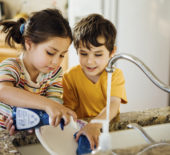
15. Don’t forget the washing-up!
Food activities don’t end when the food is ready.
Cleaning up afterwards is another opportunity for children to build independence.
Depending on their age and abilities, they might:
- Put ingredients away
- Place dishes in the sink
- Wipe the bench
- Wash utensils
- Put rubbish in the bin
- Help load the dishwasher
It might take longer than doing it yourself.
But you’re teaching a skill that will eventually save you time.
Hopefully!
Making food activities positive for kids
The most important part of these activities isn’t whether your child eats the food.
It’s whether they have a positive experience with it.
Try to avoid turning every activity into an opportunity to encourage your child to “just try it”.
Instead, allow them to explore food at their own pace.
A child might:
- Look at a new food
- Smell it
- Touch it
- Cut it
- Mix it
- Serve it
- Put it on their plate
- Lick it
- Take a bite
- Or decide they don’t want to eat it
All of these can be steps in becoming more comfortable around food.
This is particularly important for children with sensory sensitivities, food anxiety or a limited range of accepted foods.
The goal isn’t to make every school holiday activity about getting children to eat more vegetables.
It’s about helping children develop positive experiences, skills and confidence around food.
Keep it simple
You don’t need to schedule a complicated food activity every day.
Some days, getting your child to help wash strawberries or stir a bowl of pancake batter is enough.
Other days, you might have the time to make homemade pizza, grow vegetables or create an elaborate snack platter.
The best activity is one that works for your family.
And remember that mess is part of the process.
Children are learning.
They may spill things.
They may make strange combinations.
They may put far too much cheese on their pizza.
They may decide that banana, cucumber and hummus somehow belong together.
That’s okay.
Food exploration doesn’t have to be perfect.
Take Home Message
School holidays provide a great opportunity to get children involved with food without making it another chore.
Cooking, baking, growing food, creating snack platters, making smoothies and playing food-based games can all help children develop practical skills, independence and familiarity with different foods.
Most importantly, keep food activities fun and pressure-free.
Your child doesn’t have to eat everything they prepare.
Sometimes simply touching, smelling, preparing or looking at a food is a valuable step.
So this school holidays, instead of asking “What can I do to keep the kids busy?”, try asking:
“What can we make together?”
You might be surprised by where their creativity takes you!
Need more support with your child’s eating?
At Feed Your Future Dietetics, I provide individualised, neurodivergent-affirming nutrition support for children and families.
Whether your child has a limited range of accepted foods, sensory sensitivities, difficulties meeting their nutritional needs or you simply want practical guidance around creating a positive relationship with food, support can be tailored to your child’s individual needs.
Consultations are available via Telehealth across Australia.
Visit www.feedyourfuturedietetics.com or email ashleigh@feedyourfuturedietetics.com to find out more.
Feed Your Future Dietetics — helping you and your family feed your future.